AI value starts with the operating model: Metis Summit
How leading organizations turn data into decisions, and decisions into action
For years, organizations have treated technology transformation as a technology problem. AI is proving that assumption wrong.
The organizations creating lasting value are not simply deploying new tools – they are redesigning how they operate, make decisions and act on information.
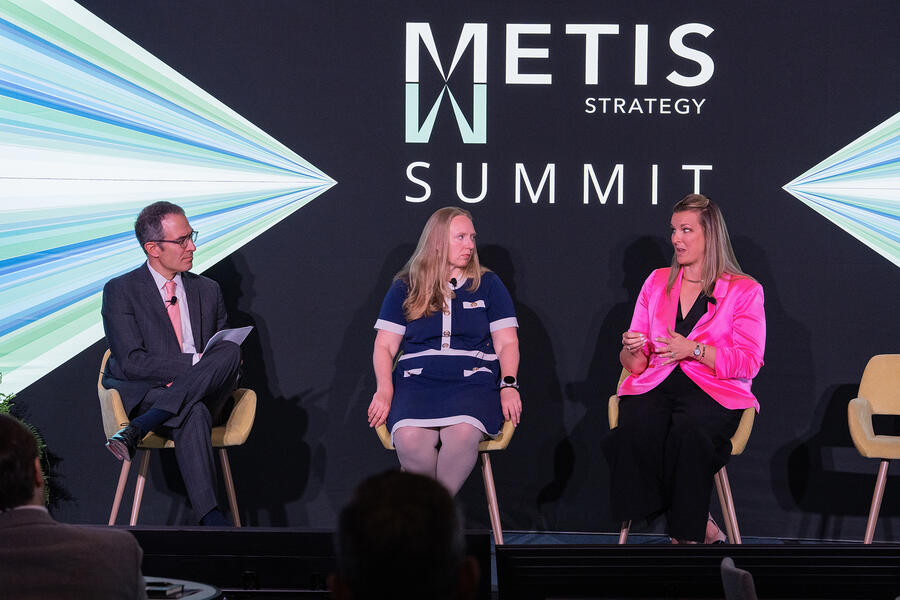
In a recent panel conversation at the Metis Strategy Summit, Leidos Chief Information Officer Alexandra Guenther joined Dr. Kelly Fletcher, CIO of the U.S. Department of State, to discuss what it takes to create meaningful value from AI in complex, mission-driven environments.
While Guenther focused on the enterprise data foundations needed for long-term AI success, Fletcher highlighted a parallel challenge at the State Department: enabling leaders to make informed decisions across a globally distributed organization. Together, their perspectives reinforced a common theme. Technology alone does not create value. Organizations create value when they can translate insight into outcomes.
AI success starts with the foundation beneath it
Many organizations are racing to deploy generative AI tools, but few have invested enough in the underlying data architecture needed to support them. As Guenther explained, AI capabilities layered on top of fragmented or poorly governed data create fragile systems that cannot scale.
Recognizing this challenge, Leidos has spent the last two years prioritizing enterprise data strategy to build a strong, reusable foundation needed for long-term AI success.
Guenther’s perspective closely aligned with themes Fletcher raised about managing technology across a highly-distributed global environment. In both cases, success depends not simply on deploying tools, but on creating operating models and data environments that support resilient, informed decision-making at scale.
Better decisions come from connected data, not isolated systems
One of the most powerful concepts Guenther introduced was the idea of a “longitudinal record” – a connected view of information across the full life cycle of work – throughout the enterprise.
Every organization generates thousands of projects, each creating a trail of information from customer engagements and proposals to project execution, financial outcomes, subcontractor relationships and closeout activities. Yet in many organizations, those activities remain fragmented across disconnected systems and business functions. The strategic opportunity comes from connecting those data streams.
By linking these data streams together, organizations can begin identifying the signals that predict success or failure earlier in the project life cycle. This is where AI becomes transformative – not simply by automating tasks, but by revealing patterns that humans alone cannot easily detect.
That emphasis on connected data and decision advantage also emerged throughout Fletcher’s discussion of the State Department’s operational environment, where leaders must synthesize information quickly across global missions, evolving geopolitical conditions and distributed teams.
AI requires a new way of measuring value
Another key theme was the need to rethink how organizations measure AI success. Many organizations still evaluate AI initiatives primarily through productivity gains, such as hours saved or labor reduction. While those metrics matter, productivity alone does not necessarily improve overall performance. The more important question is whether AI helps organizations redirect resources toward higher-value work.
Across enterprise operations and global diplomacy, the focus is increasingly shifting from simple efficiency gains to enabling better decisions, reducing operational friction and creating new capacity for mission execution.
Why AI success depends on more than technology
The conversation reinforced an important reality: organizations that succeed with AI will not necessarily be the ones deploying the most tools. They will be the ones that can adapt their operating models, make better decisions and turn insight into action faster than their peers.
As AI becomes more accessible and more capable, advantage will come less from the technology itself and more from how organizations integrate it into the way they work. The leaders creating the most impact are not waiting for perfect answers – they are creating environments where experimentation, learning and responsible scaling can happen simultaneously.
Ultimately, AI is not just a technology challenge. It is a leadership challenge. The organizations that lead will be those that can consistently turn technology into advantage: moving faster, making better decisions and adapting more effectively than those around them.