Expeditionary energy’s future: fewer convoys, more control
Three points to remember
- Fuel logistics remain a critical vulnerability in modern operations because continuous resupply slows maneuver, extends supply lines, and increases risk to personnel.
- Leidos’ ongoing participation in the ExCURSion program combines the strengths of fuel and batteries by storing energy as regenerable carbon-based fuel in a closed, rechargeable system.
- This regenerative approach to expeditionary energy aims to enable on-demand fuel production, reducing convoy requirements while increasing operational flexibility and mission endurance.
The risk of fuel in modern operations
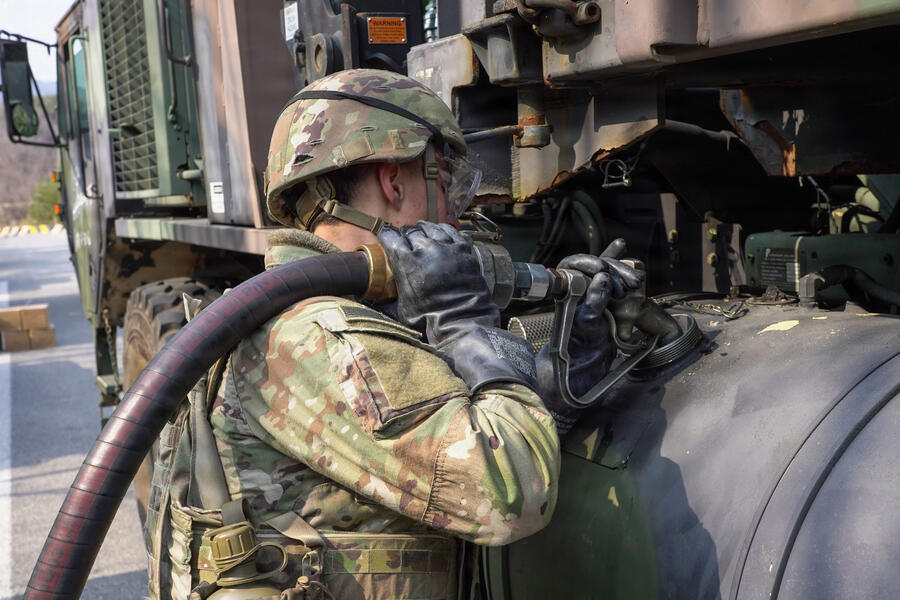
Moving fuel remains one of the most persistent risks in modern military operations. It slows maneuvers, extends vulnerable supply lines, and exposes personnel to unnecessary danger.
Leidos is working with the Defense Advanced Research Projects Agency (DARPA) to address that challenge at its root. Energy resilience is not just a technical hurdle, it is a strategic priority as missions demand more secure, adaptable, and sustainable power.
The limits of today's power options
Today, portable energy involves a fundamental tradeoff. Batteries are efficient, quiet, and adaptable, with the ability to recharge from many different energy inputs. However, their relatively low energy density limits runtime and can drive up size and weight.
Fuels, by contrast, pack far more energy into a smaller footprint, offering strong size, weight, and power performance. But they depend on ongoing resupply, imposing a logistical burden that is costly, constraining, and potentially hazardous.
A new model: the ExCURSion program
Through DARPA’s Expeditionary Carbon Utilization for Energy Resilience and Stabilization (ExCURSion) program, Leidos is helping develop a fundamentally different approach to expeditionary power.
ExCURSion aims to eliminate the tradeoff between batteries and fuel by creating a closed, rechargeable system designed to store energy as carbon-based fuel. By integrating carbon combustion, capture, and regeneration into a single platform, ExCURSion systems are intended to combine attributes of fuel-based endurance with the flexibility of a rechargeable battery, with the goal of producing fuel on demand from inputs such as carbon dioxide, water, and electricity.
Advancing the technology: 1,000 recharges
The Leidos approach to ExCURSion depends on two core innovations: 1) high-rate carbonate reduction processes performed in carefully engineered electrolytes and 2) advanced materials capable of shuttling critical chemical species between the electrodes in addition to providing chemical and physical stability to the electrochemical cells themselves.
Together, these technologies are designed to enable a system that can regenerate its own fuel, operate for extended periods, and adapt to diverse energy inputs. In partnership with the Massachusetts Institute of Technology, Leidos has demonstrated a working cell prototype that recharged rapidly and cycled up to 1,000 times in testing, representing progress toward potential operational use.
Impact at the tactical edge
“This is about fundamentally changing how energy is delivered and sustained in contested environments,” said John Dresios, division manager of Chemistry/Biology/Materials Sciences at Leidos. “By combining the strengths of batteries and fuel into a single, regenerative system, we can reduce logistical risk, increase operational flexibility, and give warfighters more control over their energy supply wherever they operate.”
The intended operational benefits include the potential for fewer fuel convoys, reduced exposure to threats, and improved mission endurance. The approach also helps reduce dependence on certain critical minerals and traditional fossil fuels, addressing both logistical and environmental considerations.
Scaling for the future
ExCURSion reflects a broader effort by Leidos to invest in resilient, scalable mission systems, from energy at the tactical edge to secure infrastructure across the mission environment. Recent strategic actions, including the acquisition of ENTRUST, are intended to expand our ability to deliver integrated capabilities aligned with evolving national needs.
Approved for Public Release, Distribution Unlimited.
This material is based upon work supported by the Defense Advanced Research Projects Agency (DARPA) under Contract No. HR001125C0012. Any opinions, findings and conclusions or recommendations expressed in this material are those of the author(s) and do not necessarily reflect the views of the Defense Advanced Research Projects Agency (DARPA).