In maritime autonomy, the math of new power is drone swarms
As their deployment matures, unmanned surface and underwater vehicles could be seen working together as a collective force
Three Points to Remember
- The cost and time needed to mass produce drone vessels are far lower than what's required to build crewed warships.
- Fleets of autonomous ships have potential capabilities to overwhelm or confuse enemies and also team up with drones in the air.
- Leidos anticipates a greater focus by the U.S. Navy on collaborative maritime autonomous operations made up of different types and modes of unmanned platforms.
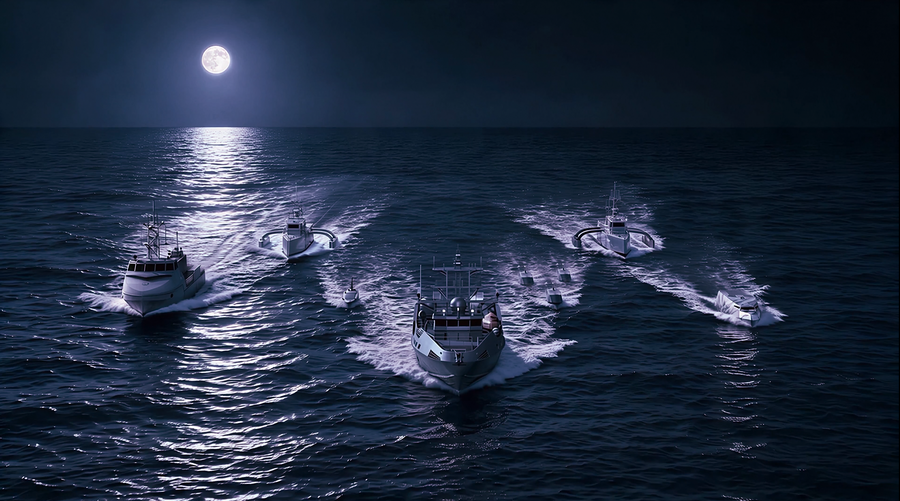
As the U.S. Navy continues large-scale investments to mature unmanned surface and underwater vehicles (USVs and UUVs), it is eyeing the concept of maritime collaborative autonomy with growing interest. For decades, projecting force has been about large, exquisitely conceived and crewed warships, but now distributed or aggregated autonomous platforms are being envisioned to work collectively and even with unmanned aerial vehicles (UAVs) to conduct swarming operations designed to confuse or overwhelm adversaries.
An armada of seafaring drones is less expensive to design and build than crewed warships, quickly amassable and sacrificial if needed to meet new operational realities. Maritime collaborative autonomy could unveil new ways of gaining advantage in conflicts and reshape how planners conceive force-amplifying effects through sheer numbers.
“It’s all about coordinated mission effects,” said Chuck Fralick, Leidos’ chief technology officer for maritime and a company vice president. “It is making 1 + 1 = 5.”
In lockstep with the Navy’s vision, Leidos anticipates that autonomous surface and subsurface platforms will be increasingly integrated not only with each other but also with the rest of the naval fleet and ingrained in strategic operations planning.

The cost of building and manning crewed vessels and the force multiplication factor that you could get from autonomous platforms are what make the latter so compelling.
Chuck Fralick
Leidos Chief Technology Officer for Maritime and Vice President
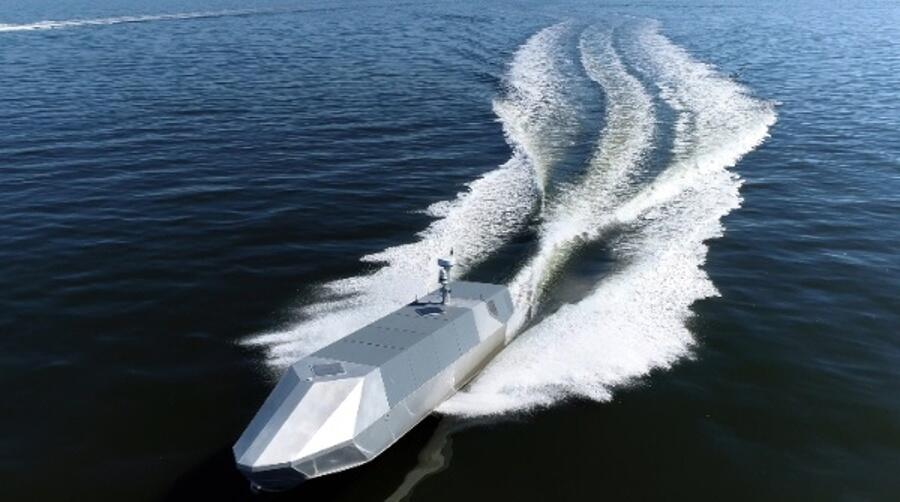
The company is building on years of autonomous operations experience for the Navy already, Fralick noted. Its Sea Hunter and Seahawk USVs have logged more than 200,000 nautical miles and 14,000 hours at sea, including a nonstop seven-month deployment in the western Pacific from 2023 to 2024. Meanwhile, it continues to develop small, low-cost UUVs and has begun production of the 9-inch-diameter version of Sea Dart for Navy customers.
The next big step is bringing the various pieces together to become a cohesive and trusted part of naval operations.
An evolution to coordinated autonomous systems
“Multimodal ‘UxV’ operations are where the real value lies and could be game-changing,” said Fralick, who, as a nuclear-trained submariner and oceanography officer during his 23-year Navy career, supported expeditionary warfare and intelligence. “If we can orchestrate swarms of USVs, UUVs and UAVs with warhead-carrying and electronic-effects payloads from multiple directions and direct them to tactically significant places, it could create significant challenges for an adversary.”
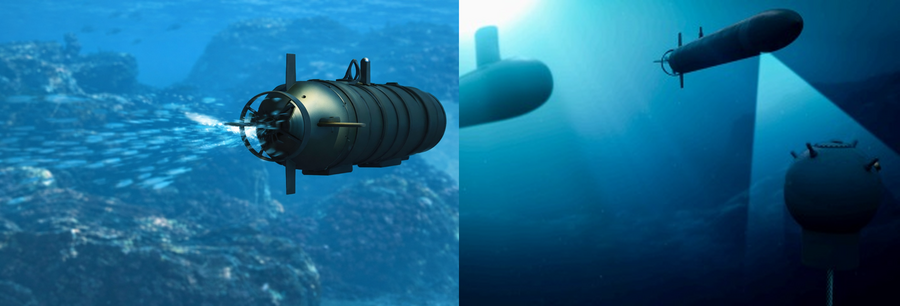
As a set of Sea Darts is being built for the Navy, Fralick pictures them being launched from a large autonomous underwater or surface vehicle and dispersing into contested waters for coordinated and widespread strikes.
Swarming operations could entail intelligence, surveillance and reconnaissance (ISR) activities, performed by groups of surface and underwater drones, taking sailors out of harm’s way while significantly improving collection capabilities.
“They have a much lower profile and therefore observability than a large, crewed submarine, so they can get in very close to sense an adversary’s systems,” Fralick noted. “USVs can make effective platforms for ISR.”
He envisions tethered quadcopters launching from small USVs like Leidos’ Sea Archer to conduct ISR. They would replace mast-mounted cameras on vessels and extend the image-collection range significantly beyond one or two miles by operating much higher above the water.
Sea Archer can accommodate aerial drones with wingspans of up to a few feet that can sense electronic signals and have a range of several hundred miles, further enhancing autonomous ISR operations for a trailing battle group, Fralick adds.
A rapid, low-cost and untiring path to readiness
The potential benefits of drone swarms go beyond amplifying effects and reducing risk to sailors. The Navy also needs to consider costs and turnaround times. Dozens of autonomous vehicles can be built for fractions of the price and time to construct a traditional vessel like a submarine.
“For 100-plus years, submarines have been the go-to ISR platform for the Navy,” Fralick said. “But a modern, fast-attack nuclear submarine is a $4 billion platform with over 120 crew members.”
Since they do not need to support human crews, therefore removing requirements like living quarters and storage of provisions, autonomous craft can be smaller and simpler, which also means they are faster and cheaper to design and build.
They can relieve strain on crew members from spending weeks or months at sea, whether the mission is ISR, hunting for mines or something more routine like surveying and mapping the ocean floor for navigational purposes. It is what Fralick calls the “three Ds” of maritime operations: dull, dirty and dangerous.
“Because I’ve done it, I can tell you that hydrographic surveying is boring as hell,” Fralick said with a laugh. “But if you can take several USVs and UUVs to ‘mow the lawn’ over wide areas, that’s very cost-effective.”
With the ability to conduct long missions with mundane tasks, autonomous systems are designed to free up crewed vessels for more tactically relevant, complex or strategic missions.
Building the architecture for collaboration
Fralick uses the queen bee analogy to describe command and control (C2) of collaborative autonomy, where a subset of systems carries the advanced intelligence and orchestrates the broader group of drones. It comprises three components: comms capabilities, then what he calls the “mission manager” followed by the C2 system.
“If you have 100 unmanned platforms, you don’t need exquisite smarts on each one but rather on a few that orchestrate movements and actions by parsing out only relevant information to those conducting individual tasks,” Fralick explained. “To do this, you must have the comms pipeline and the mission manager, which can include our AI-enabled AlphaMosaic software on the queen bee.”
The third piece is the Common Control System (CCS) in the Navy’s case. CCS is the service’s hardware-agnostic software architecture for C2 of diverse unmanned air, surface and undersea vehicles. Fralick said it’s Leidos’ job to help ensure that its autonomous platforms can connect to CCS.
“We have the orchestration software for swarming operations and the ‘cooks’ to connect to command and control, but we don’t have our own C2 software because the Navy uses CCS,” Fralick pointed out. “At the same time, we work to be compatible with our partners’ C2 systems for commercial applications or where we need exportability.”
In the future, autonomous systems could be equipped with advanced AI for agentic decision-making in communications-denied environments, when C2 isn’t available. They could adapt to adversaries and battle conditions in real time, adjusting their movements to avoid detection and operating self-sufficiently for long stretches.
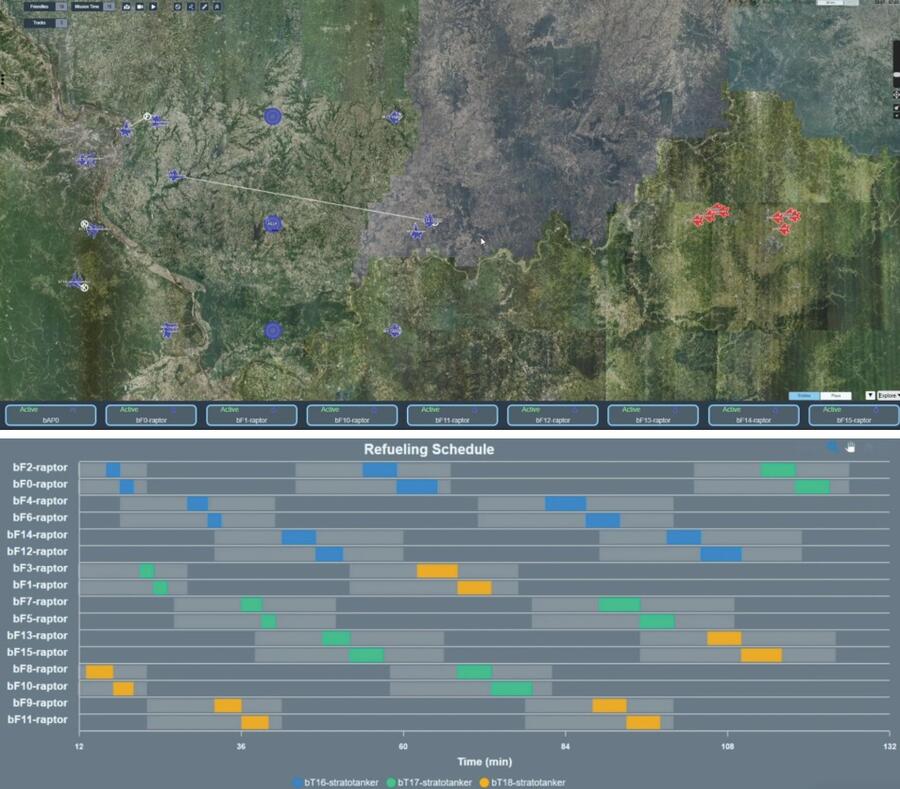
Autonomous platforms' flexibility embodies speed
Another piece of the fast-turnaround puzzle is that unmanned vehicles need to be rapidly configurable for different missions.
“Modularity is the name of the game,” Fralick said. “We don’t want anybody to have to re-engineer a vessel to add a payload. The Navy doesn’t want to build a new platform for every payload either.”
That principle is reflected across Leidos’ range of unmanned vessels. Sea Hunter and Seahawk enable 20-foot intermodal-standard containers to be bolted on and have carried a dozen different payloads so far.
For potential swarming operations with small UUVs, Sea Dart has flexible interfaces and standardized connectors that allow different payloads to be swapped in and out. With configurations supporting surface and submarine launches, the platform provides valuable mission flexibility.
“We are all about mission effects now, and they require different payloads,” Fralick said about Navy customers.
Leidos has also created a small, modular container system called Sea Pod. Designed to fit into cargo holds, Sea Pods can accommodate specific needs among payloads on a vessel. For instance, one Sea Pod can contain an HVAC system to supply cooling to another Sea Pod payload, and the same goes for auxiliary power.
“Sea Archer will hold several Sea Pods, and they can all be different payloads or one type of payload,” Fralick said. “They're designed for easy integration.”
Looking ahead with anticipation
Collaborative maritime autonomy is still evolving, but many building blocks are in place. Unmanned vehicles are expected to take on more complex and dangerous missions as the Navy becomes increasingly comfortable and creative with them. Over time, autonomous capabilities will figure to be a core part of Navy doctrine in peacetime operations and in conflicts especially.
“The cost of building and manning crewed vessels and the force multiplication factor that you could get from autonomous platforms are what make the latter so compelling in an era of drones in conflicts,” Fralick said.
MORE ON LEIDOS' MARITIME CAPABILITIES