Cyber resilience in the quantum era: building security for what’s next
Leidos sees post-quantum security as part of everyday cybersecurity, not an add-on, using new forms of encryption
Three Points to Remember
- Quantum computers are expected to break existing encryption methods, changing how we protect networks, applications and data.
- A holistic security strategy that implements post-quantum cryptography measures at every encryption point strengthens cybersecurity today and in the quantum future.
- Leidos is embedding post-quantum strategies and approaches now, preparing customers for the quantum era before it arrives.
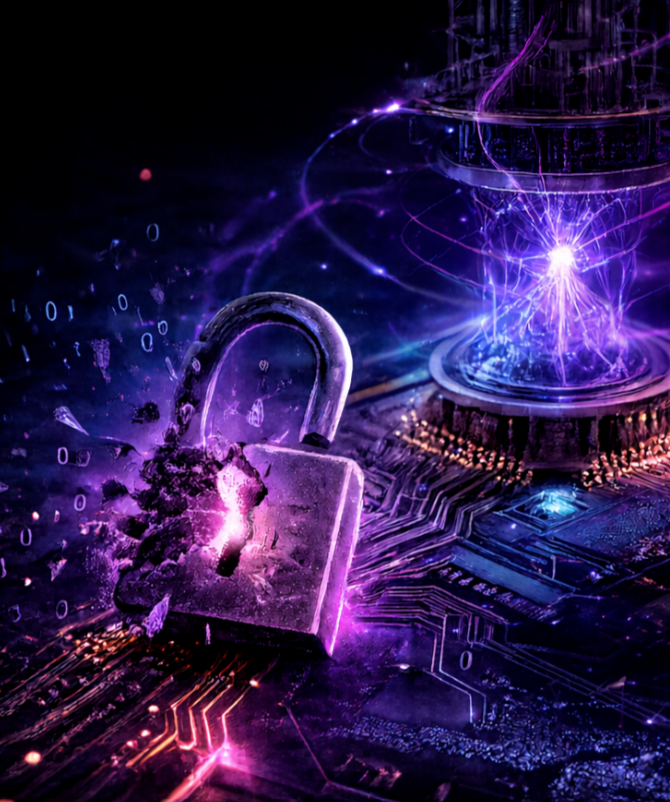
Cybersecurity is built on math – very hard math. Today’s computers, even the fastest supercomputers, can only check one possibility at a time when solving computational problems. They do it quickly, and often with many processors working side by side, but they still follow the basic rule of taking one step after another. That’s why encryption – the digital locks that protect medical records, bank accounts and government systems – has stayed safe for decades.
Quantum computers do not play by those rules.
Instead of using tiny electrical switches called chips to store information as zeroes and ones, quantum computers use qubits. A qubit is more like a spinning coin than one that's lying flat. It can be both heads and tails at the same time. This behavior lets quantum machines check many possibilities at once and narrow in on the right answer dramatically faster than today’s computers.
That’s exciting for science but dangerous for cybersecurity.
A strong encryption lock that would take today’s computers billions of years to break could be opened by a powerful quantum computer in minutes. It’s like having a giant safe protecting your most important information that's nearly unbreakable today but hackable with a tool that adversaries know is coming.
Some are already stealing encrypted data now so they can unlock it later. This tactic even has a name: “harvest now, decrypt later.”
This is why post-quantum security (often referred to as PQS) matters. Post-quantum security uses new forms of encryption called post-quantum cryptography (PQC) that's designed to resist quantum attacks and keep information secure.
Leidos doesn't see post-quantum security as an optional upgrade but rather in the same way as zero trust and AI-enabled defenses. It’s part of cybersecurity from the start with a simple goal: protect data against the threats of today and tomorrow.
“Many of the encryption methods we rely on today weren’t designed for the capabilities quantum computing will introduce," said Joe Kovba, Leidos’ vice president of digital modernization transition. "As quantum technology accelerates, so does the urgency for agencies to modernize their defenses.”

Many of the encryption methods we rely on today weren’t designed for the capabilities quantum computing will introduce. As quantum technology accelerates, so does the urgency for agencies to modernize their defenses.
Joe Kovba
Leidos Vice President of Digital Modernization Transition
Building a holistic approach to quantum-ready cybersecurity
Becoming quantum-ready isn’t as simple as replacing old encryption with new versions. It takes a full-system approach to PQC that starts with understanding every place encryption already lives.
Leidos starts with cryptographic discovery, mapping every “lock” across networks, applications and devices. From there, the company assesses risk, identifies weak spots and replaces outdated algorithms such as Rivest-Shamir-Adleman (RSA) or elliptic curve cryptography (ECC) with quantum-resistant standards approved by the National Institute of Standards and Technology (NIST).
In other words, post-quantum security is not about inventing a new lock. It’s about knowing every lock you have, upgrading them safely and checking them constantly. Leidos applies the principles of resilience and anticipation to every aspect of cybersecurity strategy, ensuring systems are ready for what’s next rather than scrambling to catch up to threats.
The company built a roadmap from experience in migrating complex systems toward post-quantum readiness, and at its core is the post-quantum remediation framework to guide organizations on the post-quantum security journey.
“While PQC is relatively new, we have been working with cryptography for decades," said Michael Mealey, a Leidos cybersecurity solutions architect.
This experience gives the company a deep understanding of how encryption works in real environments and what's required to modernize it without disrupting missions. A six-step process provides a clear, repeatable path to quantum-ready cybersecurity:
- Discover and inventory: Find where encryption is used across systems.
Prioritize risks: Identify what matters most and what needs to be fixed first.
Choose quantum-safe algorithms: Use NIST-approved PQC standards (Federal Information Processing Standards 203/204/205).
Implement and integrate safely: Upgrade protections while keeping systems running.
Validate and test: Use automated testing and simulations to ensure everything works.
Govern and future-proof: Set policies, key management and long-term compliance.
The path forward
True post-quantum readiness goes beyond technology. It depends on people and process working together, building in resilience from the start. Leidos puts this into practice across its cyber, IT and mission teams so everyone works together toward one goal: critical missions across all domains stay online and secure as threats change.
Cybersecurity in the quantum era will demand foresight, coordination and adaptability. They are qualities Leidos is building into every layer of the PQC approach.
When organizations try to add post‑quantum security at the end, problems pile up. Gaps get missed, systems work differently in different places and there are too many digital keys to manage. Updates then arrive late and all at once, which can cause downtime and make it harder to meet requirements.
Embedding PQC from the start keeps things simple. Leidos is aligning post-quantum security with our broader cyber mission because true resilience can’t be achieved through isolated measures. It requires integration across systems, missions and time horizons.
Learn more about how Leidos is embedding PQC into cybersecurity resilience by clicking below..
MORE ON LEIDOS CYBER CAPABILITIES