Imperium and the future of information operations
Three Points to Remember
Information advantage depends on the ability to understand and act on information faster than U.S. adversaries.
Imperium™ integrates awareness, planning, execution, and assessment into a single operating environment.
By reducing fragmentation across tools and workflows, Imperium helps operators move from insight to action more efficiently.
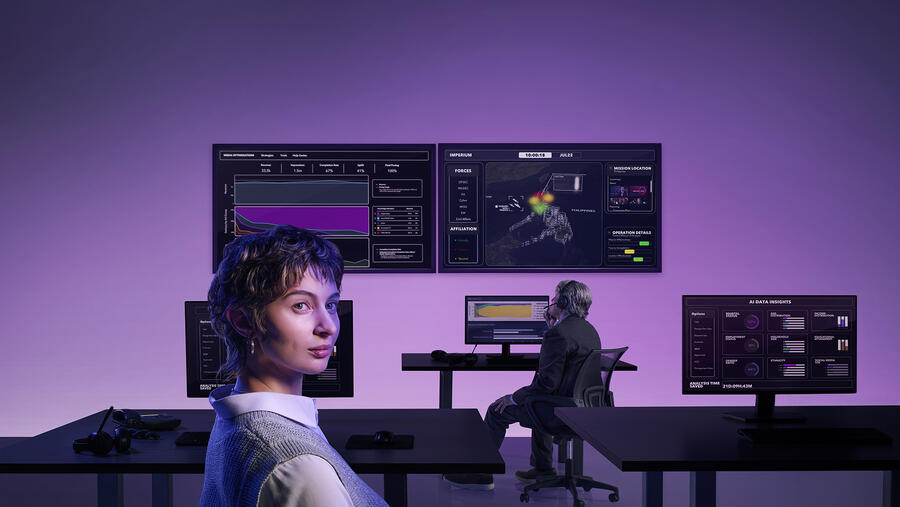
The fight for information advantage
Modern conflicts are increasingly won by those who can collect, understand, and act on information more quickly and effectively than their opponents.
Long before a physical conflict begins, competitors and adversaries are already shaping the information environment. Through influence campaigns, misleading content, and coordinated online activity, they seek to shape perceptions and affect decision-making before the first shot is fired.
As a result, information can move globally in seconds, while operational conditions can shift just as quickly.
For psychological operations (PSYOPS) and information operations (IO) professionals, the challenge is no longer access to information. It is determining what matters and responding quickly enough to maintain advantage.
Many organizations still rely on disconnected systems and workflows to support these missions. Data analysis, planning, execution, and assessment often occur in separate environments, creating delays between insight and action.
Leidos’ Imperium™ was developed to help address that challenge.
By combining AI-enabled analytics, vetted commercial and open source intelligence (OSINT) data sets with mission planning tools, and operational assessment capabilities, Imperium is designed to help IO professionals understand, plan, execute, and assess the information environment within a single dashboard.
The result is a more connected approach to operating in the information domain, one that helps organizations move from awareness to action with greater speed and confidence.
From fragmented workflows to “information operations in a box”
Information operation professionals are tasked with understanding audiences, analyzing information environments, developing influence strategies, executing messaging campaigns and assessing their effectiveness. Historically, many of these activities have been supported by separate tools, data sources and workflow assessments. That fragmentation can slow decision-making and make it difficult to maintain operational tempo in rapidly evolving environments.

Imperium is essentially PSYOPS in a box. A platform that brings together the tools, data, and workflows needed to understand, plan, execute, and assess operations in the information environment.
Ted Tanner
Chief Technology Officer, Leidos
While technology alone cannot replace the expertise and judgement of information professionals, Imperium is designed to help them work more efficiently by integrating capabilities that are often spread across multiple systems.
Imperium helps users:
Rapidly synthesize structured and unstructured data
Identify emerging narratives and influence activity
Assess audience sentiment and information trends
Develop and evaluate courses of action
Generate and refine messaging options for specific audiences
Measure effectiveness and adapt campaigns as conditions change
By connecting these functions within a single operational environment, Imperium helps reduce the time required to move from understanding a situation to taking informed action.
Bringing command and control principles to the information domain
Military organizations have long relied on command-and-control systems to coordinate operations across air, land, sea, space, and cyber domains. As information becomes an increasingly important operational domain, many organizations are looking for similar levels of visibility, coordination, and agility.
Imperium is designed to provide that operational framework. The platform helps establish a common understanding of the information landscape while supporting the decisions required to respond effectively. Users can evaluate changing conditions, consider response options, and assess outcomes within a shared operational environment.
By reducing the friction between analysis and action, Imperium helps organizations respond more quickly as conditions evolve. Mission leaders gain a clearer picture of the environment and a more efficient path from insight to execution.
The future of influence
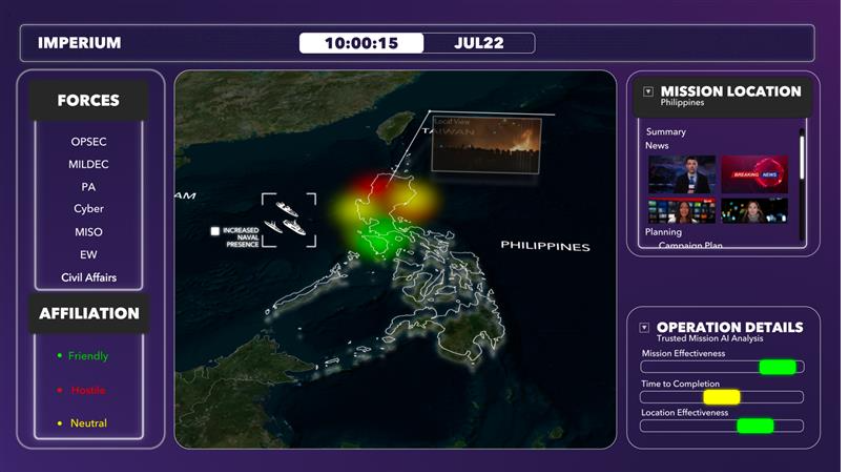
Information advantage is no longer a supporting function. It is increasingly a decisive element of modern competition, crisis and conflict. Success will depend on more than collecting data or deploying artificial intelligence tools. It will require the ability to integrate accurate, vetted information, analytics, planning, execution, and human judgment into a cohesive operational capability to carry out modern IO.
Platforms such as Imperium are helping organizations move in that direction by bringing together the technologies and workflows needed to operate effectively in the information environment.
As information becomes a central domain of modern conflict, the ability to recognize and respond to narrative shifts in real time will increasingly define operational advantage.
Forward-Looking Statement:
Certain statements in this announcement constitute “forward-looking statements” within the meaning of the rules and regulations of the U.S. Securities and Exchange Commission (SEC). These statements are based on management’s current beliefs and expectations and are subject to significant risks and uncertainties. These statements are not guarantees of future results or occurrences. A number of factors could cause our actual results, performance, achievements, or industry results to be different from the results, performance, or achievements expressed or implied by such forward-looking statements. These factors include, but are not limited to, the “Risk Factors” set forth in Leidos’ Annual Report on Form 10-K for the fiscal year ended January 2, 2026, and other such filings that Leidos makes with the SEC from time to time. Readers are cautioned not to place undue reliance on such forward-looking statements, which speak only as of the date hereof. Leidos does not undertake to update forward-looking statements to reflect the impact of circumstances or events that arise after the date the forward-looking statements were made.