Leidos helps utilities and developers tackle AI data centers' power demands
As these hyperscale data centers, designed to support AI and large-scale computing, drive unprecedented energy loads, Leidos works to help modernize the grid and enhance reliable power delivery
Three Points to Remember
- AI data centers are straining the power grid, and major system upgrades are needed to handle their significant and variable energy demands.
- Leidos helps utilities and data center developers integrate energy systems using the existing grid combined with on-site power generation and energy storage.
- Leidos is developing AI-powered tools for grid planning and power system optimization.
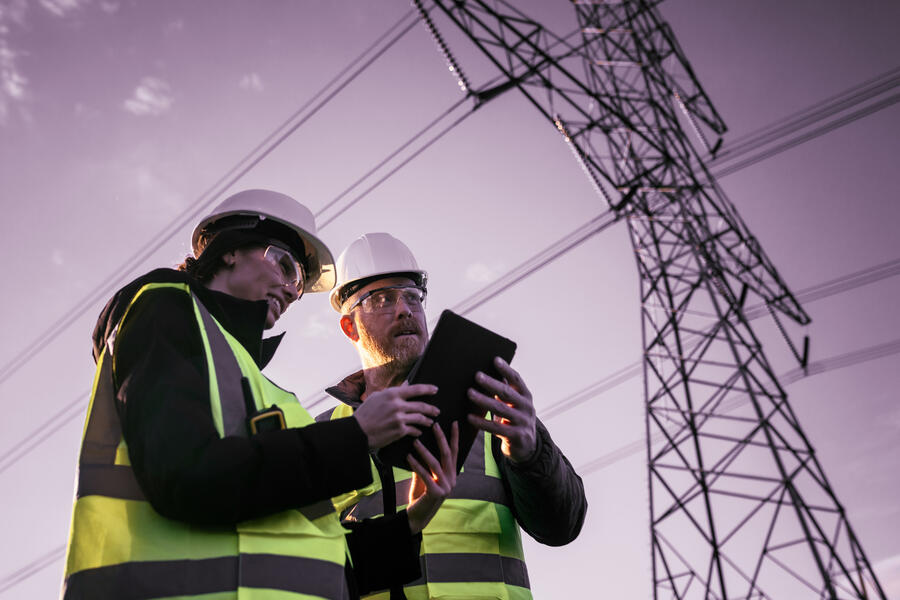
The nation’s power grid needs modernization to meet rapidly growing energy demands from an AI-powered society. As more hyperscale data centers come online to serve AI computing needs, these massive installations could consume as much as 12% of all U.S. electricity within a few years, according to the Dept. of Energy’s Berkeley Lab.
AI data centers will further stress the aging infrastructure that carries, distributes and delivers electricity, which is already under strain from factors like electrification-driven load growth and weather-related heating and cooling demands.
“The power grid is an amazing thing but has been very slow, big and complicated to build, and we don’t have enough people and time to get where we need to be,” said Josh Wepman, VP and CTO of energy, infrastructure and automation at Leidos. “We need a radically more effective way of designing and scaling the future power grid.”
The power industry is grappling with a shortfall of engineers. Through AI-powered solutions, Leidos supports utilities and system owners across the country by automating much of the daily and labor-intensive tasks of power engineering design. The master planning work to create a higher-capacity grid, Wepman said, is also well-suited for intelligent automation and human-AI collaboration.
Utilities could benefit from AI modeling and simulation that helps optimize infrastructure as the power dynamics of entire regions change with new data centers. AI-powered tools can help planners for large-scale energy development projects reach design and engineering decisions much more quickly and adapt as AI strategies evolve.

Getting AI data centers online has become an arms race. It's a matter of importance both commercially and for national security.
Josh Wepman
Leidos VP and CTO of energy, infrastructure and automation
AI data centers intensify the paradigm shift in power planning
Load growth from data centers is putting significant pressure on transmission and substation infrastructure.
Substations act as large electrical transformers, receiving electricity from long-distance transmission lines and stepping down the voltage for local lines that deliver the power. Because of their enormous and continuous power demands, hyperscale data centers require mega-sized substations, and many developers are working with utilities to build ones located on site.
“There are very few 1-gigawatt-plus substations in the power grid,” Wepman noted. One gigawatt, equaling 1,000 megawatts, is approximately half the power generated by the Hoover Dam.
“Getting AI data centers online has become an international arms race,” he added. “It’s a matter of importance both commercially and for national security, and developers are in a ludicrous-speed hurry.”
Market analysts put the volume of U.S. hyperscale data centers at above 600, and the typical installation requires 100 to 150 megawatts of peak power. But their number and size are expected to rise quickly with the proliferation of AI computing.
Match game: bridging capacity and load differences
At these installations, the power-dense, high-intensity hardware for performing AI computations and the advanced cooling systems for managing heat require immense around-the-clock power.
Data center developers are making sure that installations have the power capacity to run nonstop by adding on-site energy production and storage atop the utility-provided baseload power. These co-generation schemes have as much to do with having contingency power in case of outages as supplementing the grid supply during peak periods.
More and more, Leidos provides power systems engineering support for co-generation at data centers. The company works with project partners to plan and integrate on-site power solutions, which are typically natural-gas-fired powerplants and lithium-ion battery energy storage systems.
“Hyperscalers are attempting to develop data centers faster than traditional utility project cycles,” said Chris Houle, VP of power delivery solutions in Leidos’ Commercial and International Sector. While developers work with utilities on long-term upgrades, “they have to decide how to make up for the energy they need in the short term,” he said.
In some cases, that deficit can be significant. And with AI data centers, the swings in computational demand, and therefore energy needs, can be massive.
AI workloads, particularly those for training or running deep learning models, can quickly change by hundreds of megawatts due to GPU processing demands. Together with usage volumes that can also vary greatly, this presents new challenges in power system operations.

Data centers change how we think about power systems. These are mega-projects that the U.S. hasn't done in a long time.
Chris Houle
Leidos VP of power delivery solutions
Managing much larger and more frequent load fluctuations has also become an important aspect of Leidos’ power engineering work. Leidos is developing solutions to handle energy densities that are orders of magnitude greater than those of typical commercial office buildings.
Akin to a car’s suspension going over a road full of potholes and bumps, Leidos engineers integrate advanced load management to keep the power supply stable during wider-ranging load variances, using battery energy storage systems and other devices to absorb and release energy to compensate.
“The load ramps and reductions are anticipated to be faster and more frequent than traditional large loads served by the grid,” Houle noted. “These data centers change how we think about power systems. Even a 10% demand swing at a gigawatt data center is 100 megawatts of load change.”
Micro to macro support for power industry partners
By working in tandem with the utility supply, the “behind-the-meter” generation and storage at data centers form, in effect, private microgrids powerful enough to sustain small cities.
“These are the largest microgrids the industry has ever had to build,” Wepman said. “The developers’ value proposition to their customers is to keep the ginormous power farms going and serving the need. No developer wants a $5 billion data center that keeps tripping offline.”
“These are mega-projects that the U.S. hasn’t done in a long time,” Houle added. He noted that on some projects, Leidos is “working from tip to tail” with utilities, developers and construction companies on master planning, owner’s engineering and site execution.
Both he and Wepman noted that the company has introduced generative AI-powered tools to projects and is working on more advanced AI to help partners optimize power distribution and plan transmission systems faster and more effectively.
They hinted that the AI being developed and trained will accelerate analytical capabilities and problem-solving of complex and capital-intensive power projects. The technologies will strengthen Leidos’s collaboration with industry partners in grid planning and development.
“The grid will undergo its biggest transformation since the time it was built, and AI technologies are letting humans rise to the challenge,” Wepman noted.
“It’s a challenge that’s moving fast,” Houle remarked.