From disks to digital: Modernizing Navy software delivery at RIMPAC
How Leidos quickly integrated existing Navy software into its tactical edge platform
Why it matters
- Faster delivery puts capabilities into Sailors’ hands sooner
- Existing software can run without being rebuilt
- RIMPAC strengthens maritime readiness across the Indo-Pacific
Why software delivery needs to move faster
After 45 years helping the Navy deploy software, Chris Johnson witnessed a new chapter during Rim of the Pacific 2026, the world's largest international maritime exercise.
Johnson, a senior solution architect at Leidos, spent 20 years on active duty with the Navy and another 25 as a Navy civilian delivering software to ships. For much of that time, new capabilities reached the fleet by hand: engineers boarded ships carrying tapes, CDs or DVDs, and installations could take anywhere from a day to several weeks.
This process can make it harder to deliver and update software across shore-based and shipboard systems, particularly as the fleet becomes more connected and dependent on rapidly evolving digital capabilities.
How Maritime Mission Edge works
Maritime Mission Edge addresses this challenge. The Leidos platform is designed to make software easier to deploy and manage without relying on time-intensive installs aboard ships.
Maritime Mission Edge provides a common, secure environment for existing Navy applications, allowing them to run consistently from shore to ship. The platform supports both modern and legacy applications without requiring them to be rebuilt for a specific operating environment. The goal is to give Sailors more reliable access to the software they need wherever they operate.
"Five years ago, when I was with the Navy, I was still sending engineers to ships with physical media to install software," Johnson said. "Today, we're demonstrating a platform that can deliver those updates remotely. It's much like updating your smartphone – you don't plug it into a computer anymore."
How Maritime Mission Edge supported cyber monitoring at RIMPAC
Working from the Naval Information Warfare Center Pacific's Combined Test Bed in San Diego, Johnson and a team of Leidos engineers helped the Navy assess ship cyber health using Maritime Mission Edge.
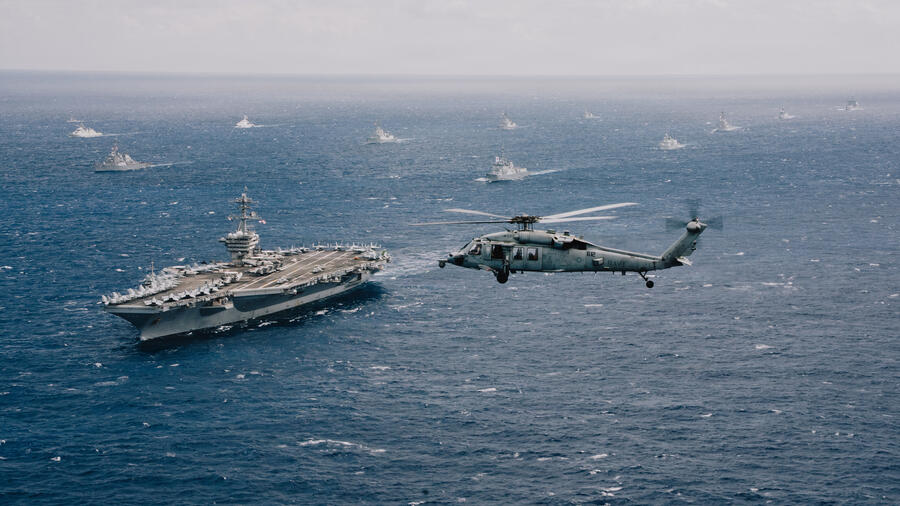
As USS Theodore Roosevelt (CVN 71) sailed to Hawaii for RIMPAC, a Navy cyber application monitored the ship’s cyber posture. Running on Maritime Mission Edge at the Combined Test Bed, the application securely received data from the ship, allowing Navy teams on shore to monitor its cyber status while the carrier remained underway.
For David Smithbauer, lead architect of Maritime Mission Edge, the exercise put Leidos’ capability to a real-world test.
"Working with the Navy during RIMPAC provided practical, hands-on feedback that emphasized the need for this capability to be in the hands of Sailors today," Smithbauer said. "Running existing Navy mission software securely at the tactical edge during an operational exercise validated our approach while reinforcing that we're building solutions that address operational needs."
From an unfamiliar application to operational
The Leidos team received the Navy cyber application leading up to RIMPAC. Although they had never worked with it before, the team learned its design, integrated it into the Leidos solution and had it operational for the exercise. The rapid integration demonstrated that this mission application could run on Maritime Mission Edge without being rebuilt or modified for the platform.
“Seeing how easily we could take an unfamiliar application, fit it into our platform and accomplish the mission was hugely satisfying,” Johnson said.

Maritime Mission Edge isn’t tied to one specific operating environment. We’ve put it on different systems and seen it work the same way. As an engineer, this blows me away.
Chris Johnson
Senior Solution Architect, Leidos
Beyond the lab: Why real-world testing matters
Throughout the exercise, the Leidos team monitored operations from the Combined Test Bed and communicated with personnel aboard Theodore Roosevelt. The team also evaluated platform performance and gathered lessons to improve Maritime Mission Edge for future missions.
"Field testing a solution is different from building and testing in a lab," Smithbauer said. "There are always new requirements, challenges and adjustments that must be made to get everything working together seamlessly. Beyond the technical integration, the ability to interact with end users provides an entirely new dimension that just can't be replicated in a lab environment."
What RIMPAC revealed about the future fleet
RIMPAC brought together more than 30,000 personnel from 30 nations to strengthen readiness and partnerships that support maritime security across the Indo-Pacific.
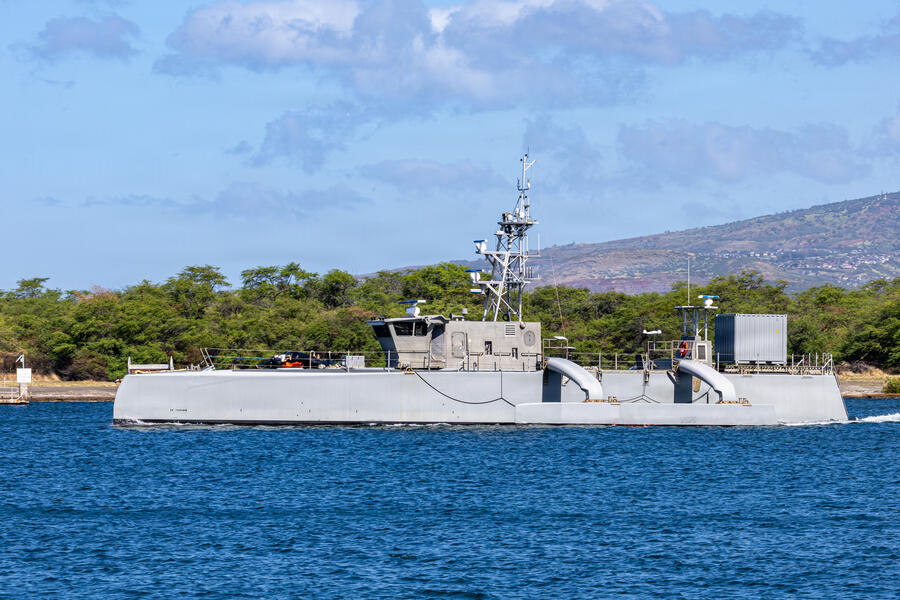
In addition to Maritime Mission Edge, the U.S. Navy’s Sea Hunter, developed by Leidos, also participated in RIMPAC, serving as the only medium unmanned surface vessel.
Using the Leidos Autonomous Vessel Architecture, Sea Hunter demonstrated the maturity of Leidos’ technology, operating autonomously more than 2,000 nautical miles from Pearl Harbor, Hawaii, to San Diego, California.
During the exercise, Sea Hunter conducted autonomous surveillance and manned-unmanned teaming, highlighting its ability to operate as part of a larger naval force as well as a stand-alone platform.
This accomplishment showcases Leidos’ extensive experience moving maritime autonomy from development and testing into sustained operation in realistic, complex environments, providing a proven foundation for future autonomous naval systems.
While serving different operational needs, the technologies reflected a broader shift toward a more connected fleet – one where software can reach Sailors faster and autonomous systems can extend the Navy’s reach.
For Johnson, however, the lasting impact was seeing firsthand how maritime software delivery has evolved.
"I've spent decades delivering software the fleet depends on," Johnson said. "Seeing what we accomplished during RIMPAC showed how far we've come. It's rewarding to know we're helping build the next generation of capability for Sailors."
Key takeaways
- Leidos quickly integrated an unfamiliar Navy cyber application into Maritime Mission Edge for the exercise.
- RIMPAC provided Leidos engineers direct feedback from Navy end users.
- Maritime Mission Edge aims to give Sailors more reliable software access wherever they operate.